

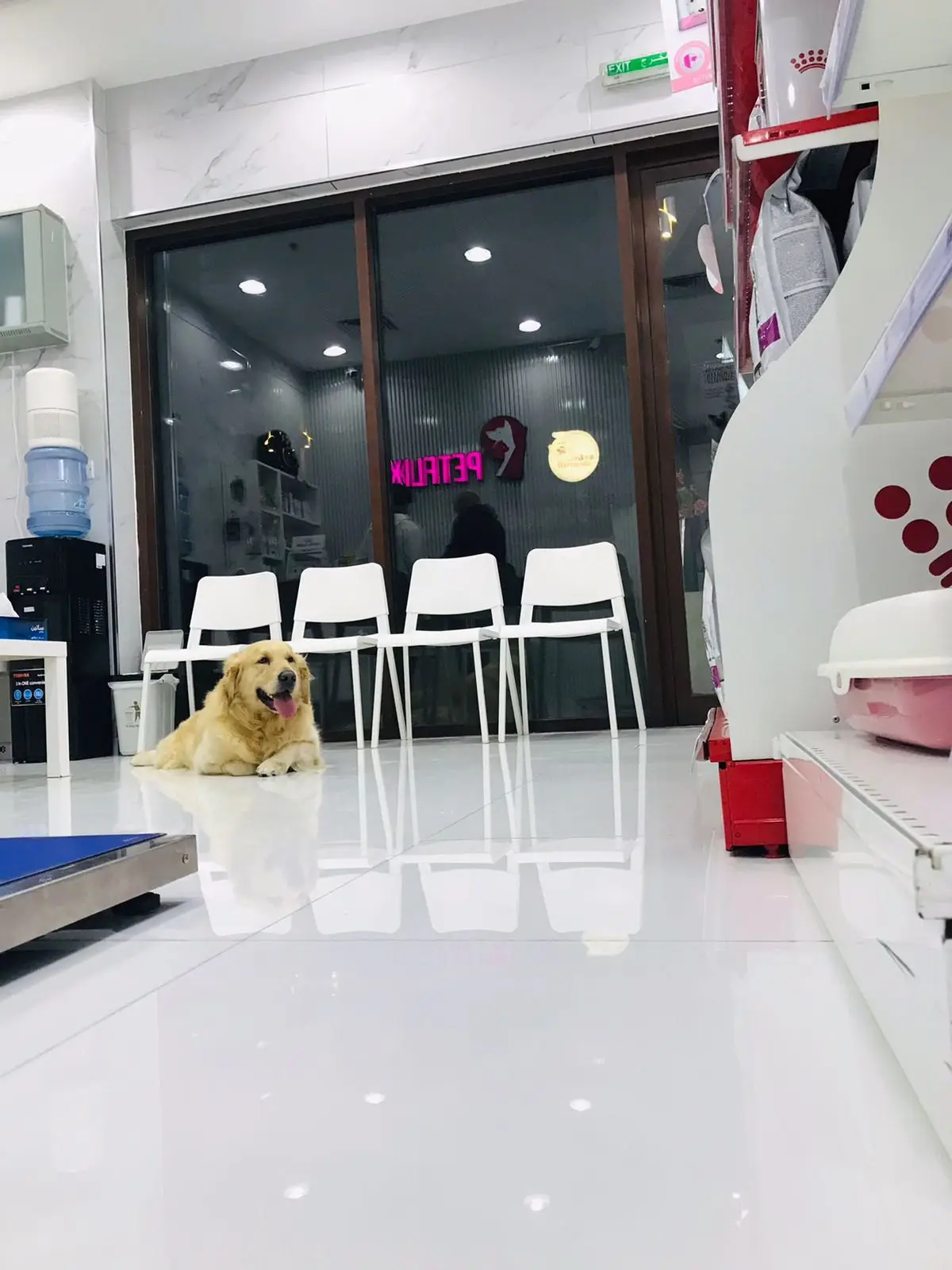
Call the clinic before you pick up the car keys. The call takes two minutes and it decides where you drive, what you do in the car and what is ready when you arrive. The Petflix phone, 055 620 4085, is answered 24 hours. The clinic is open 8 AM to 12 AM every day.
The rest of this page covers the ten minutes between noticing the problem and closing the car door. It is written for cats and dogs in Dubai flats and villas, where a lift, a basement car park and a hot car all sit between you and the vet.
Minute one is the phone call
Phone first, even if you are sure you need to come in. After midnight the nurse will tell you which hospital is open and nearest to you. Before midnight she will tell the vet what is arriving, so oxygen, a drip or the x-ray room can be ready.
Put the phone on speaker and stay next to your animal. If someone else is at home, one person calls and the other gets the carrier.
What will the nurse ask?
The questions are short and they follow the same order every time. Answer with what you can see, not with a guess at the cause.
- Species, breed, age and rough weight.
- What happened and when it started.
- Whether he is breathing normally, and what colour his gums are.
- Whether he can stand and walk.
- Anything he may have eaten, with the name on the packet.
- Any medicine he takes and any illness he already has.
Pink gums are normal. White, grey, blue or brick-red gums are not, and the nurse will want to know. If looking in the mouth would get you bitten, say so and skip it.
For a male cat that keeps visiting the litter tray, the nurse will ask whether any urine is coming out. A blocked bladder in a male cat cannot wait for morning.
How do you move an injured dog or cat?
An animal in pain bites, including one that has never bitten anyone. Move slowly, speak quietly and keep your face away from his.
Dogs
A large dog that cannot walk travels on a stretcher. A thick blanket, a bath towel or the parcel shelf from the car boot all work. Slide him on with two people, one at the shoulders and one at the hips. Keep his spine straight and do not let his head hang.
A soft muzzle or a loop of bandage round the nose protects you while you lift. Never muzzle a dog that is vomiting, struggling to breathe or has a flat face. A small dog can be carried in a laundry basket or a box lined with a towel.
Cats
A cat goes in a carrier, always. A frightened cat carried in your arms through a car park will jump, and you will lose her. If she will not go in head first, stand the carrier on its end and lower her in back legs first. A top-opening carrier is easier still.
If she is fighting, drop a thick towel over her, wrap it under her and lift the whole bundle. A cat that has fallen from a balcony should lie flat in the carrier with as little handling as possible. Falls can cause fractures and chest injuries that do not show on the outside.
Bleeding
Press a clean cloth firmly on the wound and keep it there. If blood soaks through, add another cloth on top. Do not lift the first one to look. Do not tie anything tight around a leg.
Cool the car before the animal gets in
From May to October a car parked outdoors in Dubai is hotter inside than the air outside. A dog in shock or a cat that cannot breathe well will get worse in that heat within minutes.
Send someone down to start the engine and run the air conditioning on full. If you are alone, start the car, then go back up for your animal. Basement parking helps, but the cabin still needs a few minutes.
- Put the carrier on the back seat or the floor behind the front seat, never in a closed boot.
- Point one air vent towards the carrier, not straight into the face.
- Cover a cat carrier with a light towel, leaving the front open for air.
- A second person sits in the back with a large dog. The driver only drives.
If the lift in your tower is slow, call it before you lift the dog. Tell building security you have an emergency and ask them to hold the door.
What should you bring?
- The packet, plant or object if he has eaten something. A photo of the label is enough.
- The vaccination book, or a photo of its pages.
- Every medicine he takes, in its box.
- A phone video of the seizure, the breathing or the limp.
- A charged phone, with the clinic number saved.
- A spare towel. It is a blanket, a stretcher and a cleaning cloth.
Do not spend time looking for any of these. If it is not within reach, leave without it.
What should you not do?
- No food and no water. He may need sedation or an anaesthetic within the hour.
- No human painkillers. Common ones are poisonous to cats and dogs.
- Do not make him vomit unless the nurse tells you to. Some swallowed things do more harm coming back up.
- Do not pour cold water over a collapsed animal or pack him in ice.
- Do not drive fast. A calm 15-minute drive is safer than a frightening 10-minute one.
What happens when you arrive?
Park as close to the door as you can and leave the engine running if someone can stay with the car. Go in and tell reception you called. An animal with breathing trouble, heavy bleeding or collapse is seen ahead of the queue.
The vet examines him first and stabilises him if he needs it. After that you get a written estimate for tests and treatment before anything else is done. The price list for consultations and common procedures is published, so the first figures should not surprise you.
When to call
Call 055 620 4085 now if your dog or cat is struggling to breathe, has collapsed or is bleeding heavily. Call now after a seizure, a road accident or a fall from a height. Call as well if you are not sure.
The nurse will tell you whether to come to urgent care at Petflix in Ras Al Khor, go to a nearer open hospital, or watch him at home until morning.