

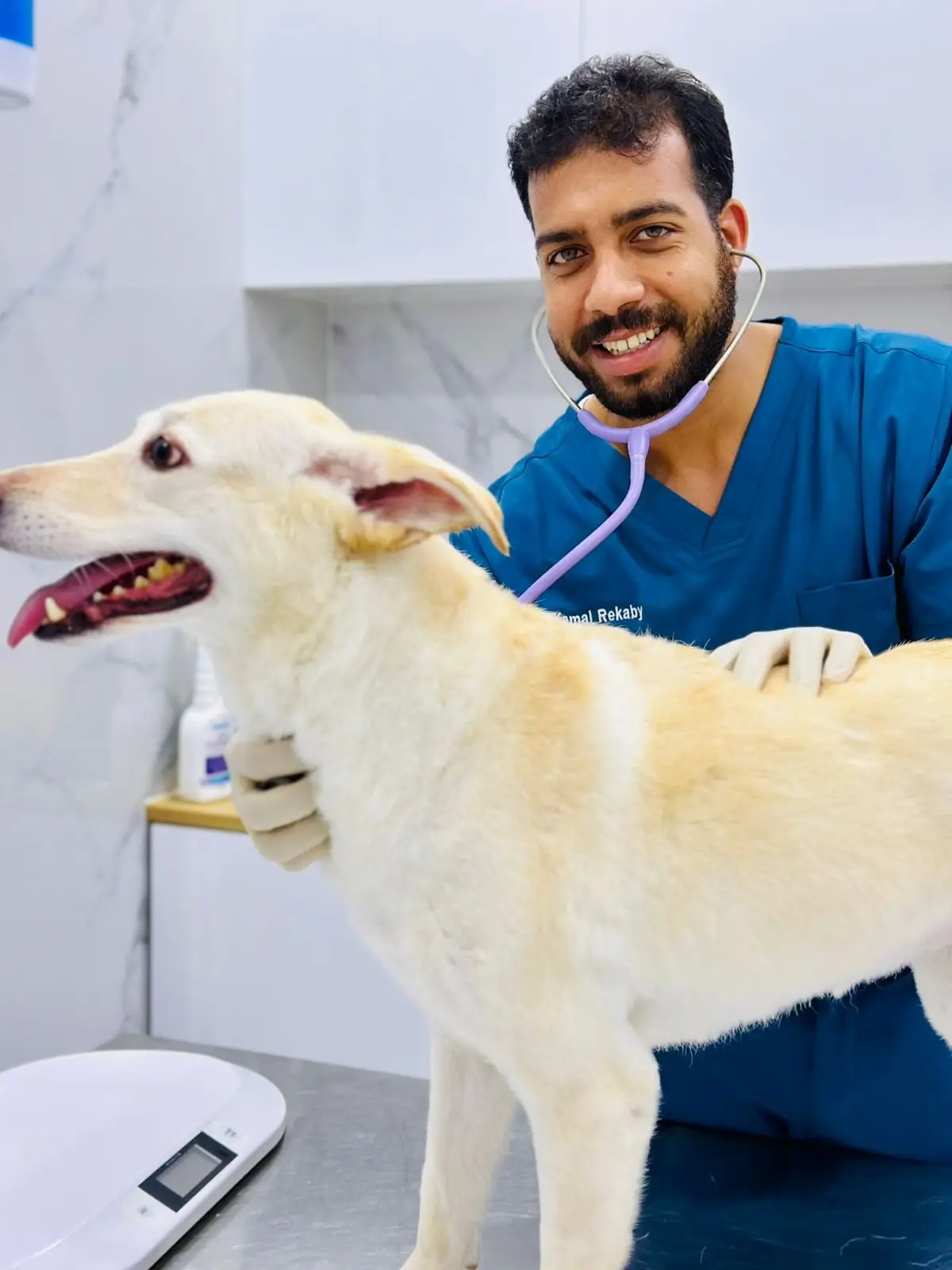
During a dog seizure, keep your hands away from his mouth, move the furniture away from him and start a timer. Cornell’s Riney Canine Health Center says to time it, because a seizure lasting more than five minutes is the life-threatening state called status epilepticus.
At five minutes, Cornell’s instruction is to go to the veterinary clinic immediately, so leave rather than waiting for anyone to pick up. Our phone, 055 620 4085, is answered 24 hours and the clinic is open 8 AM to 12 AM every day, and after midnight call first so we can name the nearest open hospital.
What should I do in the first five minutes?
Six things, in this order, and none of them involves touching his head. Tufts Cummings School of Veterinary Medicine puts the principle simply, which is to move objects away from your pet that could cause harm but not to move or pick up the dog himself.
- Start a timer, because Cornell says to time the seizure and keep a log, and because a seizure can feel far longer than it is.
- Pull the chairs and tables away from him, and Cornell adds that you should stay below him on the stairs if you can do it safely, so he cannot fall further.
- Turn off the television, dim the lights, turn the air conditioning down and send the children and other animals out of the room.
- Film 20 to 30 seconds of it, because Cornell notes the vet has to decide whether the event was a seizure at all and a video can be immensely helpful.
- Stay close and speak quietly, since he cannot hear you in the usual sense but a calm room helps in the recovery that follows.
- Send someone to cool the car at three minutes and leave at five, which is our own advice rather than a published rule.
What should you never do during a dog seizure?
Four things, and the first one is the one that gets owners bitten. Cornell is direct about it, saying to avoid your dog’s mouth so that you do not get bitten, because he is not aware of his surroundings and is not in control of his movements.
- Do not put your hand, a spoon or anything else near or inside his mouth. Tufts gives the same instruction, which is not to try to put your fingers or an object in his mouth.
- Do not hold him down or try to stop the movements, and do not pick him up unless he is somewhere dangerous.
- Do not give food, water or any medicine by mouth during the seizure or the confused phase afterwards, because he can choke on it.
- Do not hug him as he comes round. Cornell warns that the confusion afterwards can be expressed as aggressive behaviour, so a disoriented dog can bite a face he has known for years.
How long does a dog seizure last?
Cornell puts a typical one at a few seconds to a few minutes, with the seizure itself lasting seconds to minutes. Neither Cornell nor Tufts gives an average beyond that.
The number that matters is five. Cornell describes status epilepticus as an ongoing seizure that does not resolve on its own, typically considered more than five minutes, and the 2024 ACVIM consensus statement on status epilepticus in dogs and cats confirms that researchers and clinicians have broadly adopted the five-minute time frame as its defining element.
If it stops while you are driving in, Cornell says to sit tight for a little, and that if your dog stays quiet the life-threatening emergency is over, although he still needs to be seen. So keep going rather than turning the car around.
When is a dog seizure an emergency?
Cornell gives two triggers for a dog seizure in one sentence, saying an active seizure lasting more than five minutes, or multiple seizures in a 24-hour period, is a medical emergency, and that all cases of status epilepticus are life-threatening while some clusters can be too. Come in at once for any of the following.
- The seizure passes five minutes on your timer.
- He has multiple seizures in a 24-hour period, which is Cornell’s wording for a cluster. If he has a second one the same day, call us.
- A second seizure starts before he has recovered consciousness from the first, which the International Veterinary Epilepsy Task Force, as reported in the 2024 ACVIM statement, counts as status epilepticus in its own right.
- It is his first seizure, since Cornell says a first-time seizure should always prompt a veterinary exam.
- He may have eaten something toxic, and Cornell names dark chocolate, caffeine, the sweetener xylitol, anti-freeze, rat poison and liquor.
- He is a young puppy, is diabetic, or is pregnant or nursing.
- He was outside or in a car in the heat before it started.
The ACVIM statement explains why clusters are not a lesser version of the same problem, noting that clusters, especially when they come close together, can carry a similar risk of seizure-related brain injury, can progress into status epilepticus, and are unlikely to stop without treatment.
Read also: Rat poison and cockroach bait in Dubai buildings
What does a dog seizure look like?
A classic dog seizure is hard to mistake. The dog falls on his side and goes stiff, his legs paddle, his jaw chomps and he drools, he may pass urine or stool, and his eyes are open while he neither sees you nor answers to his name.
Smaller ones are easier to miss, where one side of the face twitches, he snaps at the air, or a single leg jerks while he stays on his feet. These focal seizures count, and Cornell warns that a focal seizure can segue into a generalised one, so keep a close watch until it passes.
What happens before and after a seizure?
Cornell names three phases. In the pre-ictal phase there may be subtle behavioural changes such as restlessness or anxiety, which some owners recognise afterwards as the clinging or hiding that came first. The ictal phase is the seizure itself.
Then comes the part that frightens people most. Cornell describes the post-ictal phase as a recovery period in which the brain is resetting, marked by confusion, disorientation and lethargy, with some dogs showing food craving, and it says this can run from minutes to hours after the seizure. Pacing, bumping into walls and seeming blind all belong to it.
What looks like a seizure but is not?
A heart problem or a balance problem can both look like one. Cornell explains that an intermittent cardiac arrhythmia can cause confusion, weakness and collapse that is mistaken for seizure activity, and that cardiac collapse tends to be softer, more closely resembling fainting, with a quicker recovery.
Cornell names a balance, or vestibular, event as the other thing to tell apart from a seizure. This is the best argument for the video, because the difference is visible on a phone screen and almost impossible to convey in words at the reception desk.
Why does heat matter so much in Dubai?
Because a seizure makes its own heat. Cornell explains that if a dog is in status epilepticus too long he could die, because the intense physical activity pushes the core body temperature to life-threatening levels.
It runs the other way as well, since Cornell lists seizures among the clinical signs of heatstroke, which happens when a dog cannot regulate his temperature and it rises to 105 degrees Fahrenheit or higher. Cornell names the dogs most at risk as flat-faced breeds such as pugs and bulldogs, along with elderly, overweight, thick-coated and dark-coated dogs.
So keep the room cold during the seizure and cool the car before he goes into it. For heatstroke, Cornell’s advice is to start cooling immediately by wetting the dog with cool water and placing him in front of the car’s air conditioning on the way to the hospital. Use cool water rather than ice, which is our own advice, and tell the nurse on the phone that he feels hot.
Tufts advises a fixed routine for giving the medication and says family travel and refills have to be planned for. Ramadan and travel season both shift household routines by hours, so keep his tablets on his clock rather than yours and collect refills from the pharmacy before they run out. Walking before sunrise or after dark in summer is our own advice.
What causes seizures in dogs?
Age is the first clue, and Cornell sets out the pattern clearly. Breed matters too, and Cornell reports higher rates of seizure conditions in Schnauzers, Collies, Bassett Hounds, Cocker Spaniels, Labrador Retrievers and Golden Retrievers than in other breeds.
- Cornell says dogs younger than a year are more likely to have a congenital defect, an intoxication or an infectious disease such as distemper, which is one reason vaccination is not a formality.
- Between six months and six years Cornell gives idiopathic epilepsy as the usual answer, where the dog is normal between seizures and every test comes back clean.
- For a dog over six years at his first seizure, Cornell says a metabolic disorder or a structural problem in the brain is more likely, so the search goes wider.
Causes outside the brain are on the list at any age. Cornell names metabolic disorders such as low blood sugar or low blood calcium, liver disease, liver shunts and kidney disease, which is why the first tests look at the body rather than the head.
How do vets find the cause of seizures?
If he is still seizing when you arrive, the vet stops the seizure and brings his temperature down, and the questions come afterwards. The ACVIM statement lists addressing complications such as overheating alongside treating the underlying cause as vital to the outcome.
Once he is stable, the examination checks his nervous system and the tests look outside the brain first. Cornell lists blood work, meaning a complete blood count and a biochemistry panel, together with a urine test, to assess overall health and rule out systemic illness. Our in-house laboratory runs those the same day, and he may stay in the inpatient ward while we watch him.
The diagnosis of epilepsy is one of exclusion. Cornell’s rule is that if no abnormalities are found in a dog who has had at least two seizures 24 hours apart, a tentative diagnosis of idiopathic epilepsy is made, and it names MRI as the test best suited to rule out structural problems in the brain, which is done at a referral hospital.
Long-term medication is a separate conversation, made with you at a consultation rather than in the emergency room. Bring the diary, because Cornell says tracking when the seizures happen, what occurred, how long it lasted and how he behaved before and after will help your vet manage treatment, and Tufts calls a seizure diary a proactive way to identify triggers. Fees are on the price page and you get a written estimate before anything beyond first aid.
Read also: Same-day vet lab results, what we run and what we send out
When should I call the vet about a seizure?
Call 055 620 4085 during the seizure if someone else can watch him, or the moment it stops. Say how long it lasted, whether it was his first, and whether he feels hot to the touch.
The nurse will tell you whether to come to urgent care at Petflix now or to book for the next day, and after midnight she will name the nearest open hospital.
Frequently asked questions
Short answers to what owners search for after a dog seizure, from pain to recovery.
Is a dog seizure painful?
Tufts Cummings School of Veterinary Medicine states it plainly, that seizures are not painful. He is not aware of his surroundings during one, which is the same reason Cornell warns that he cannot control his movements and may bite without meaning to.
Can a dog die from a seizure?
From a long one, yes. Cornell says a dog in status epilepticus for too long could die, because the core body temperature rises to life-threatening levels. A single short seizure in a dog who recovers fully is a different situation, and Cornell says to schedule a veterinary exam as soon as possible.
Why is my dog confused after a seizure?
That is the post-ictal phase, which Cornell describes as the brain resetting after the abnormal activity, with confusion, disorientation and lethargy, and sometimes a craving for food. Cornell says it can last from minutes to hours, so give him a quiet room rather than attention.
Can heat cause a dog seizure?
Cornell lists seizures among the signs of heatstroke, which it defines as a dog unable to regulate his temperature when it reaches 105 degrees Fahrenheit or higher. In a Dubai summer that makes a parked car, a closed balcony and a midday walk three versions of the same risk.