

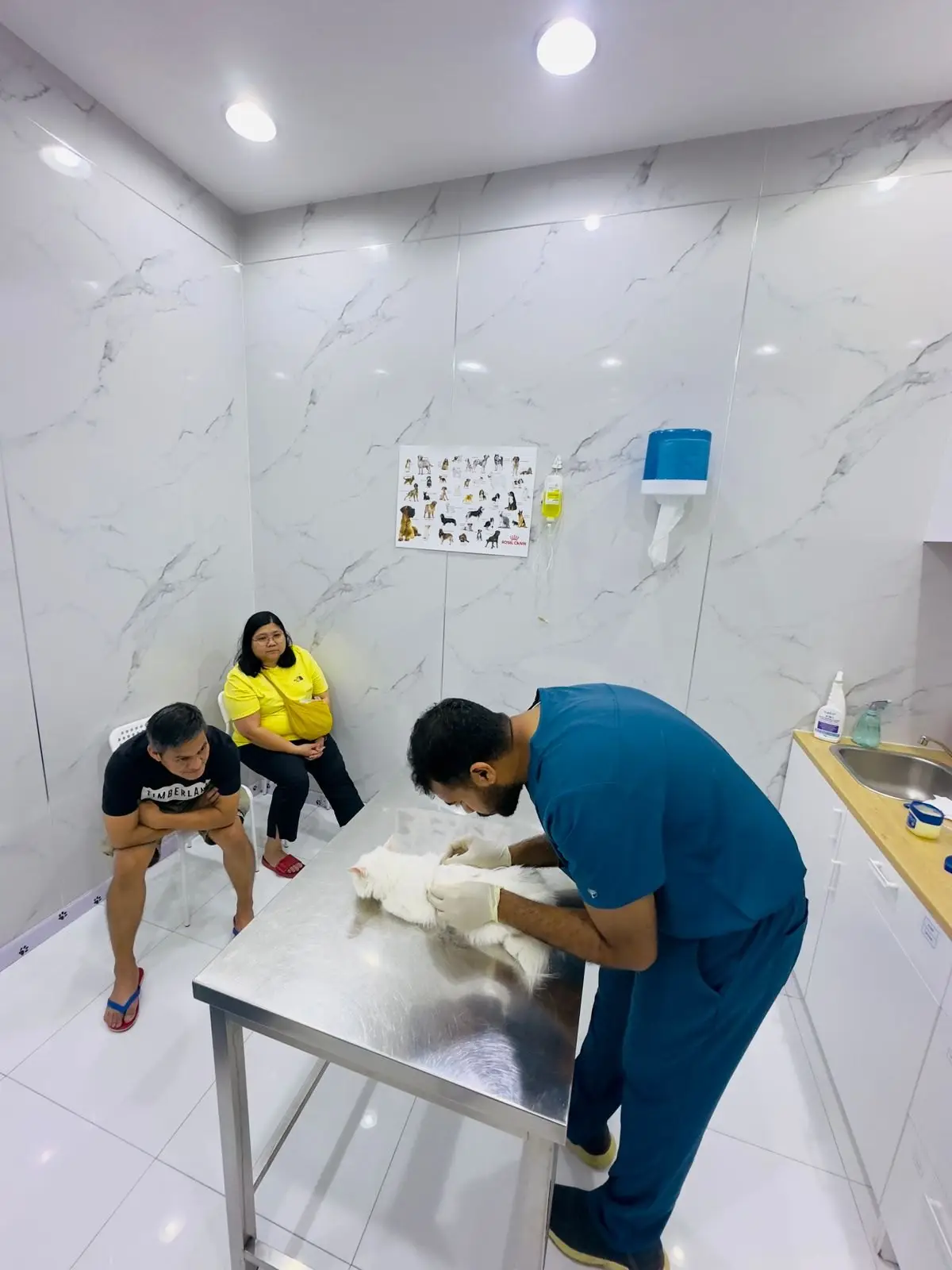
Start with the licence, then choose a vet on the things you can see in one routine visit. In the UAE the Ministry of Climate Change and Environment issues licences to veterinary facilities and to vets, so that part is checkable rather than a matter of taste, and the rest of this page is what to look at once you have.
Use an ordinary appointment to choose a vet, such as a vaccination or a check-up, because an emergency is the wrong moment to discover how a clinic works. We are open 8 AM to 12 AM every day and the phone is answered 24 hours on 055 620 4085.
How do I check a vet is licensed in the UAE?
Ask to see it, because we could not find a public register to look it up in. The Ministry of Climate Change and Environment licenses veterinary facilities, describing a service that covers veterinary hospitals, clinics, laboratories, pharmacies and advisory offices, and says the licence is valid for one year from the date of issuance.
People are licensed separately from premises. The same ministry licenses the professions themselves, listing junior, practising, specialist and consultant veterinarians alongside veterinary assistants, technicians, nurses and laboratory technicians, and that approval also runs for one year.
There is a third licence that rarely comes up. The ministry states that it is prohibited for any licensed veterinary facility to carry out radiological activity, including possessing, using or storing radiological sources, without a licence issued by the Federal Authority for Nuclear Regulation. So an x-ray room is not something a clinic can simply install.
Locally, Dubai Municipality says it monitors and certifies veterinary establishments, clinics and pharmacies to ensure compliance with applied health conditions. Between the three, asking a clinic to show you its licences is a fair question with a documented answer behind it.
What does veterinary accreditation mean?
Less than the articles telling you to choose a vet by accreditation imply, and it is worth knowing before you go looking for a badge. The American Animal Hospital Association, which runs the best-known scheme, says the veterinary world does not have required standards or accreditations and that getting any kind of accreditation is voluntary for all practices.
It is also uncommon. AAHA says around 15 percent of practices achieve its accreditation, assessed against nearly 50 mandatory standards and almost 900 in total, covering pain management, client services, surgery and emergency care. In the UK the Royal College of Veterinary Surgeons describes its Practice Standards Scheme the same way, as a voluntary accreditation, with practices assessed every four years.
Neither scheme operates as a local benchmark here, so advice to choose a vet by looking for an American or British accreditation does not travel well. The licences above are what actually apply in this country.
What should I ask before I choose a vet?
Five questions, and you can ask them all at a vaccination appointment. WebMD’s list for owners covers much of the ground, naming whether tests and procedures are done on site, whether the practice provides specialist referrals, whether it accepts walk-ins, and how it handles emergencies and after-hours care.
- What do you give me in writing before a procedure, and what is in the estimate.
- Who watches my animal while she is under anaesthetic, and from when until when.
- Which tests and images can you do in this building, and what do you send out.
- What are the consulting hours, and what happens if she is ill after you close.
- If I move or want another opinion, how do I get her records.
The sections below are what a good answer to each of those sounds like. The order is ours rather than anyone’s guideline.
Should a vet give a written estimate first?
Yes, and the MSD Veterinary Manual lists providing cost estimates before carrying out any treatments or procedures among the characteristics of a quality veterinary clinic. In our view a clinic should examine your animal first, then put the recommended tests or procedure in writing. At Petflix you get a written estimate before any procedure, and the only thing that does not wait for paperwork is first aid for an animal in danger.
- Each item listed separately, including the anaesthetic, blood tests, medication and rechecks.
- VAT shown as either included or added, so the final figure holds no surprises.
- A range where the outcome is uncertain, and what would push the cost to the upper end.
- A phone call for your consent if what the vet finds during a procedure changes the plan.
AAHA adds a fair caveat, saying never be afraid to ask for a quote while remembering that since your pet cannot tell you what is wrong, you may meet unexpected expenses along the way.
A published price list is our own marker of a clinic comfortable being compared, and ours is on the price page. AAHA notes that a quick phone call can provide you with a quote, though our own view is that a figure for an animal nobody has examined, or a package price that does not say what is inside it, is worth questioning.
Who watches my pet under anaesthetic?
It is the question we would ask, and the one that gets lost because the surgeon gets the attention. The 2020 AAHA anaesthesia and monitoring guidelines describe the standard as patient-specific anaesthetic monitoring performed by a dedicated anaesthetist, which means somebody whose only job during the procedure is to watch your animal. At Petflix a nurse monitors every anaesthetic.
The risk is low to begin with. AAHA puts anaesthetic-related death in healthy dogs at 0.05 percent, or one in 1,849, and in healthy cats at 0.11 percent, or one in 895, and notes that death most frequently occurs in the first three hours after the operation.
That last detail is why recovery matters as much as surgery, and AAHA says monitoring of the recovering patient should be maintained with the same vigilance as during the anaesthetic itself. The list below is our own, and it is what we would want answered before we let anyone anaesthetise our own animal.
- The vet examines the animal on the morning and listens to the heart before anything is given.
- A pre-anaesthetic blood test is offered, and discussed for older animals and those with any illness.
- An intravenous line is placed, which AAHA calls optimal anaesthetic patient care in almost all situations.
- One person monitors heart rate, breathing, oxygen and temperature from induction until she is awake.
- Pain relief is given before, during and after the procedure rather than only afterwards.
- Somebody stays with her in recovery, which is where AAHA puts the highest risk.
Flat-faced breeds, the Persians, Exotic Shorthairs, French bulldogs and pugs we see most, need their own answer. AAHA says brachycephalic dogs and cats are more prone to upper airway obstruction and have been shown to have higher airway-related anaesthetic complication rates than other breeds, so ask how the clinic handles them on waking. Our surgery page sets out the day step by step.
Read also: What a pre-anaesthetic blood test checks in cats and dogs
What should a clinic have on site?
Enough that a diagnosis does not take a week. A clinic that sends every blood sample out and refers every image adds days, and in this climate it adds car journeys too. WebMD puts the question simply, which is to ask whether tests and procedures can be done on site.
- A laboratory for blood and urine, with same-day results on common panels.
- Digital x-ray, which under the rules above needs its own nuclear-regulator licence.
- Ultrasound, for the soft tissue that x-rays do not show.
- Rapid tests or PCR for infectious disease such as parvovirus and the feline viruses.
- An inpatient ward, with somewhere separate for infectious cases.
- A pharmacy stocking prescription diets and long-term medicines.
Petflix has all six of those in the building. What a clinic does not do matters as much when you choose a vet, though, and MSD says that if your pet develops a complicated medical problem your regular vet can refer to a specialist, while AAHA suggests asking whether a practice has that specialist in-house or partners with one elsewhere.
CT, MRI and the more involved heart work belong in a referral hospital, and we say so when your animal needs them. A clinic willing to tell you where its own line is makes it easier to choose a vet than one that claims to do everything.
Read also: Same-day vet lab results, what we run and what we send out
Does the vet clinic open at night?
Ask before you need the answer. AAHA frames it as knowing whether your vet’s office has emergency hours, because that tells you whether you need a backup plan, and MSD notes that emergency clinics exist to provide care when regular offices are closed.
- The actual consulting hours, not just the hours someone answers the phone.
- Whether walk-ins are accepted or every visit needs an appointment.
- Friday, weekend, Ramadan and public holiday hours, which are the ones we get asked about after they have caught somebody out.
- What happens after closing, and whether the clinic will tell you where to go.
Ours is 8 AM to 12 AM every day with walk-ins, and the phone is answered 24 hours. After midnight the line is for advice, and the nurse will direct you to the nearest open hospital if your animal cannot wait until morning, while urgent care runs until midnight.
Think about the route as well, because the distance on the map is not the drive, and it is worth knowing how far you will carry a cat in a carrier in August. Call or WhatsApp 055 620 4085 to book, or walk in.
Can I take my pet’s records to another vet?
You should be able to, and it is worth testing early rather than during a dispute. The UK’s Royal College of Veterinary Surgeons makes it a professional duty there, saying vets and veterinary nurses must provide copies of any relevant clinical records at the request of a client. No equivalent UAE rule exists that we could find, so here it is a question of practice rather than law.
- You get lab results, images and discharge notes as files when you ask for them.
- The vaccination book is completed, stamped and signed at each visit, with the microchip number on it.
- The clinic sends the history to another vet on request.
- Instructions after a procedure are written down rather than only spoken.
That includes taking them for a second opinion. WebMD’s advice is that if you are not happy with the care your pet has received, or you think the diagnosis or approach is wrong, you should consider getting one, and that you can ask your own vet to refer you to a colleague or specialist. We give second opinions on other clinics’ cases and expect ours to be checked the same way.
What should a good vet do in the room?
A few things need no questions at all, and they are what we would watch for if we had to choose a vet ourselves.
- The vet examines the whole animal rather than only the part you came about.
- Your animal is weighed, so there is a number to compare against next time.
- The options are explained, including doing nothing yet, with what each would cost.
- Cats are handled quietly and kept away from barking dogs where the layout allows it, which MSD lists as separate waiting areas for dogs and cats, while noting this is not always possible.
- The table is cleaned between patients in front of you.
When should I change vets?
When the answers above stop coming, or stop being straight. Wanting to look again is not disloyalty, and a practice that makes leaving awkward has told you something about itself.
Take the records with you, keep the vaccination book, and give the new clinic the history rather than starting from nothing. A second opinion is a smaller step than a move, and it is worth trying before you choose a vet somewhere else.
Frequently asked questions
Short answers to what owners search for when they set out to choose a vet in Dubai.
How do I know if my vet is good?
By the answers to the five questions above rather than the waiting room. MSD’s own markers are modest and practical, naming cost estimates before treatment and separate waiting areas for dogs and cats, and AAHA’s accreditation standards cover pain management, surgery and emergency care.
Are online reviews worth reading?
They tell you about reception, waiting times and manner, which matter. They cannot tell you who monitored an anaesthetic or what was in an estimate. That is our view rather than a sourced finding, and we would weigh a visit far above a star rating.
Does my vet need to be AAHA accredited?
No. AAHA itself says accreditation is voluntary and that around 15 percent of practices hold it, and the scheme is not a UAE standard. The ministry licence is the requirement that applies here.
What should I bring to a first visit?
The vaccination book, the microchip number, any previous lab results you hold, and a list of current medicines and food. Book an ordinary consultation as the test visit, and bring the five questions with you.