


A stray cat you have just picked up needs three things in its first week, and only one of them is food. It needs a room of its own, an examination before it meets any animal you already own, and a plan for the two viruses that a rapid test can settle in the same visit.
We are a paid veterinary clinic in Ras Al Khor rather than a shelter, so there is no free care and no rehoming service here. We are open 8 AM to 12 AM every day and the phone is answered 24 hours on 055 620 4085.
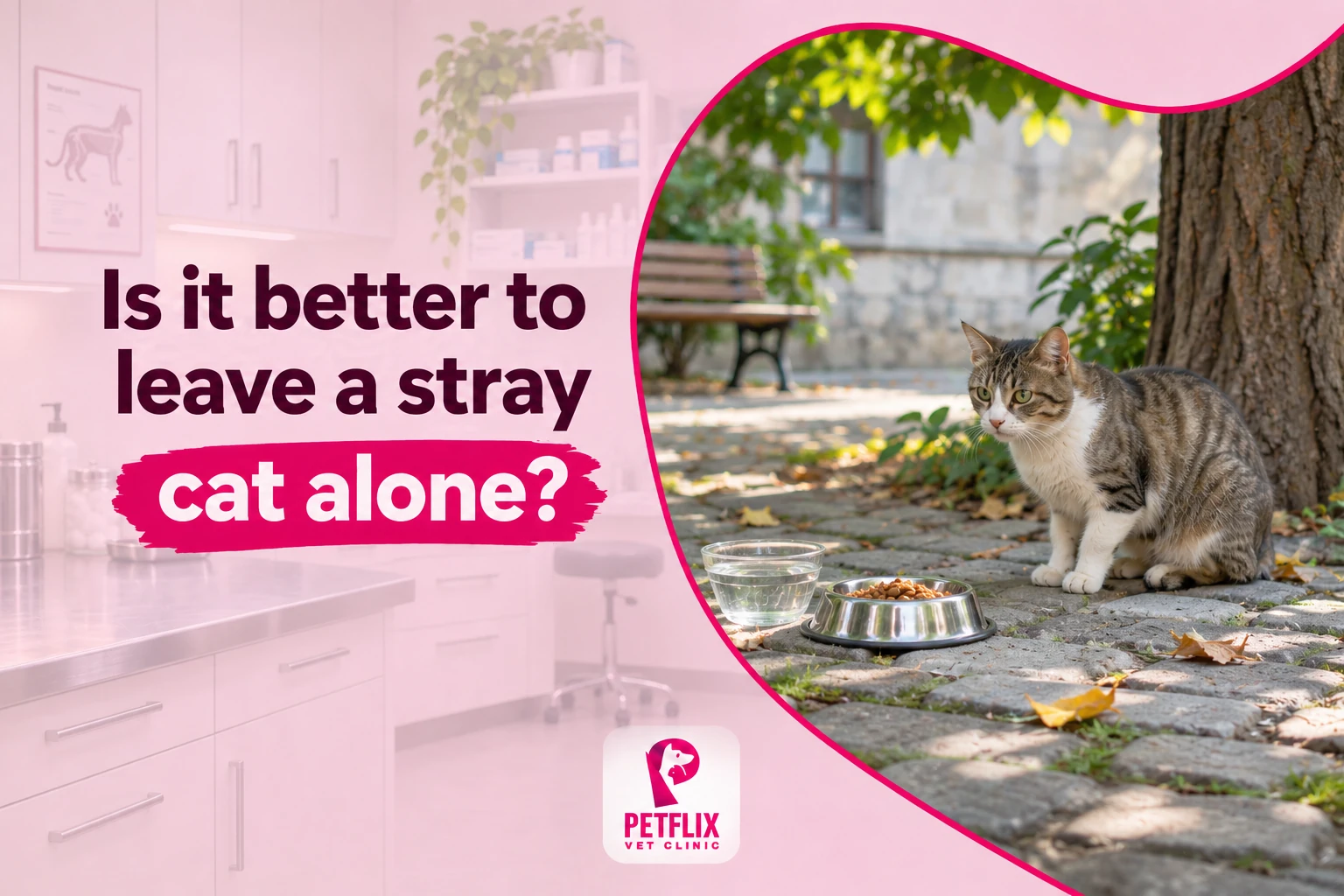
Is it better to leave a stray cat alone?
Yes, when the cat is adult, healthy and keeping its distance. A community cat that runs from you has a territory and a routine, and taking it indoors replaces both with a cage. The cats worth acting on are the ones that cannot act for themselves.
- A cat that is bleeding, dragging a limb, or will not get up needs a vet the same day.
- A kitten alone with no queen in sight, and no queen returning after a few hours of watching from a distance.
- A cat that walks up to people, lets itself be handled and looks well fed, which is a lost pet rather than a street cat.
- A cat with a closed or discharging eye, or one breathing with its mouth open.
For a hurt cat, call 055 620 4085 before you drive, so the emergency team is ready. After midnight the clinic is closed and the nurse on the line will direct you to the nearest place that is open.
Read also: Is this urgent tonight or can it wait?
Is the cat a stray or someone’s pet?
Four signs separate them, and none is conclusive on its own. A collar, a clipped ear tip, body condition, and how the cat behaves when a stranger reaches towards it.
A clipped left ear tip marks a cat that has already been neutered and returned under a municipal programme, which means it has a place outdoors and should go back to it. A well-covered cat that greets strangers is far more likely to be a pet that got out than a stray cat that has never had a home.
The one check that gives a real answer is the microchip. We read chips at the consultation, the same scanner used for the municipality tag and the export certificate, and a registered chip turns a found cat into a phone call. No chip is not proof of anything either way, since plenty of owned cats in this city were never chipped.
Where can I take a stray cat in Dubai?
To a vet if it is hurt or sick, and to a rescue group if what you need is rehoming. Those are two different problems and we only solve the first one.
Be clear with yourself before you drive. We will examine, test, vaccinate, treat and board a cat you bring in, and every one of those has a published fee on our price list. We do not take ownership of cats, we do not keep them until a home appears, and there is no charity fund here that covers the bill.
If you intend to keep the cat, the first visit is the useful one. If you do not, find the rescue group first and bring the cat to us with that arrangement already made, because a cat with nowhere to go after the examination is in a worse position than before.
How do I keep a rescued cat from my own cats?
A separate room for two weeks, with its own bowls and its own litter tray, and an examination before the door opens. That is the rule on our PCR testing page, which puts it plainly for rescued street cats.
Two weeks is not an arbitrary number. Merck gives the incubation period for feline panleukopenia as usually two to seven days and in some cases up to fourteen, so a cat that is still well on day fifteen was not carrying it when you found it. Cornell notes that in the early stages of feline leukaemia infection it is common for cats to show no signs of disease at all.
Hygiene in that room matters more than the door. Merck reports that without proper disinfection the panleukopenia virus can persist in the environment for up to a year, and that quaternary ammonium products have been found ineffective against parvoviruses in multiple field studies despite label claims. Wash your hands between cats and keep the trays apart.
What tests does a street cat need first?
A full examination plus a blood test for the two retroviruses. Our new pet or rescue check covers age, sex, ear mites, fleas and ringworm on a stray cat, and the vet may advise a test for feline immunodeficiency virus and feline leukaemia before the cat meets anything else.
Cornell is firm on why that test comes first, stating that all cats should be tested for feline leukaemia before being introduced into a home, and that food and water bowls and litter boxes should not be shared between infected and uninfected cats. It also warns that a single test at one time point is not enough to settle a progressive infection, and that a cat with a possible recent exposure should be retested after three to six weeks.
If the cat is sneezing, has a runny eye or has loose stool that will not settle, a swab tells you which organism it is. Our PCR panels cover the cat flu viruses and the diarrhoea causes including panleukopenia and Tritrichomonas, and our laboratory runs the blood work in house. A kitten under six months may need a repeat test as it grows.
When can a rescued cat be vaccinated?
On the first day it is well enough, which is not the same as the first day it arrives. A cat with a fever, diarrhoea or an active infection is treated first and vaccinated once the temperature is normal.
Our cat vaccination packages run in two visits. The first covers the examination, the first viral dose, deworming, the microchip and the official pet passport, and the second follows twenty-one days later with the second viral dose and the rabies vaccine. A kitten can start the first package at eight weeks.
There is a reason not to wait longer than the cat’s health requires. Merck reports that panleukopenia infection rates remain high in feral, free-roaming and pet cat populations with limited access to preventive care, and that cats showing signs of viral enteritis are usually between four weeks and two years old. A rescued kitten sits squarely in that window.
What if the rescued cat turns out sick?
Call before you arrive and tell us what you have seen, so the cat goes to the isolation ward rather than the waiting room. That is the instruction on our page for feline panleukopenia, where a rapid stool test gives an answer in about ten minutes.
Anything that could spread goes to the isolation ward in our boarding and hospitalisation wing, cat flu and ringworm included, at the nightly rate on the price list. Merck describes the duration of acute panleukopenia as seldom more than five to seven days, which is why an admission is counted in nights rather than weeks.
One thing for you rather than the cat. If a frightened cat bites or scratches you while you are handling it, see a doctor about it the same day, whatever the wound looks like.
Read also: Is cat open mouth breathing an emergency?
How do you make a stray cat feel at home?
By giving it somewhere to hide and then leaving it alone. A cat that has lived outdoors reads an open flat as exposure, and the fastest route to a settled cat is a small quiet room it can own for a fortnight.
- A covered bed, a cardboard box or the space under a chair, so the cat can watch the room without being seen.
- Food at set times in the same place, rather than a bowl that is always full.
- A litter tray away from the food and away from the door.
- No lifting, no cuddling and no visitors for the first few days, and let the cat come to you.
- Water in more than one spot, which matters in this climate.
If the coat is matted or flea-bitten past combing, that is a job for a groomer rather than a brush at home. Our page on matted and aggressive cat grooming explains when sedation becomes the kinder option.
What if the cat you found is pregnant?
A scan answers it, and the timing of the scan decides what it can tell you. Our ultrasound service confirms pregnancy and counts what it can see, and our page on pregnancy scan timing says which week gives which answer.
There is a second reason to scan a pregnant stray cat early. Merck reports that panleukopenia in a pregnant queen spreads across the placenta and can cause resorption, abortion or stillbirth, and that infection around birth can damage a kitten’s cerebellum and leave permanent tremors. Her vaccination history, which for a found cat is usually unknown, is part of the conversation.
Can a street cat be neutered here?
Once it is yours and living indoors, yes, and on exactly the same terms as any house cat. Our cat neutering page says we operate on cats that live with an owner, and that there is no trap-neuter-return or ear-tipping service here.
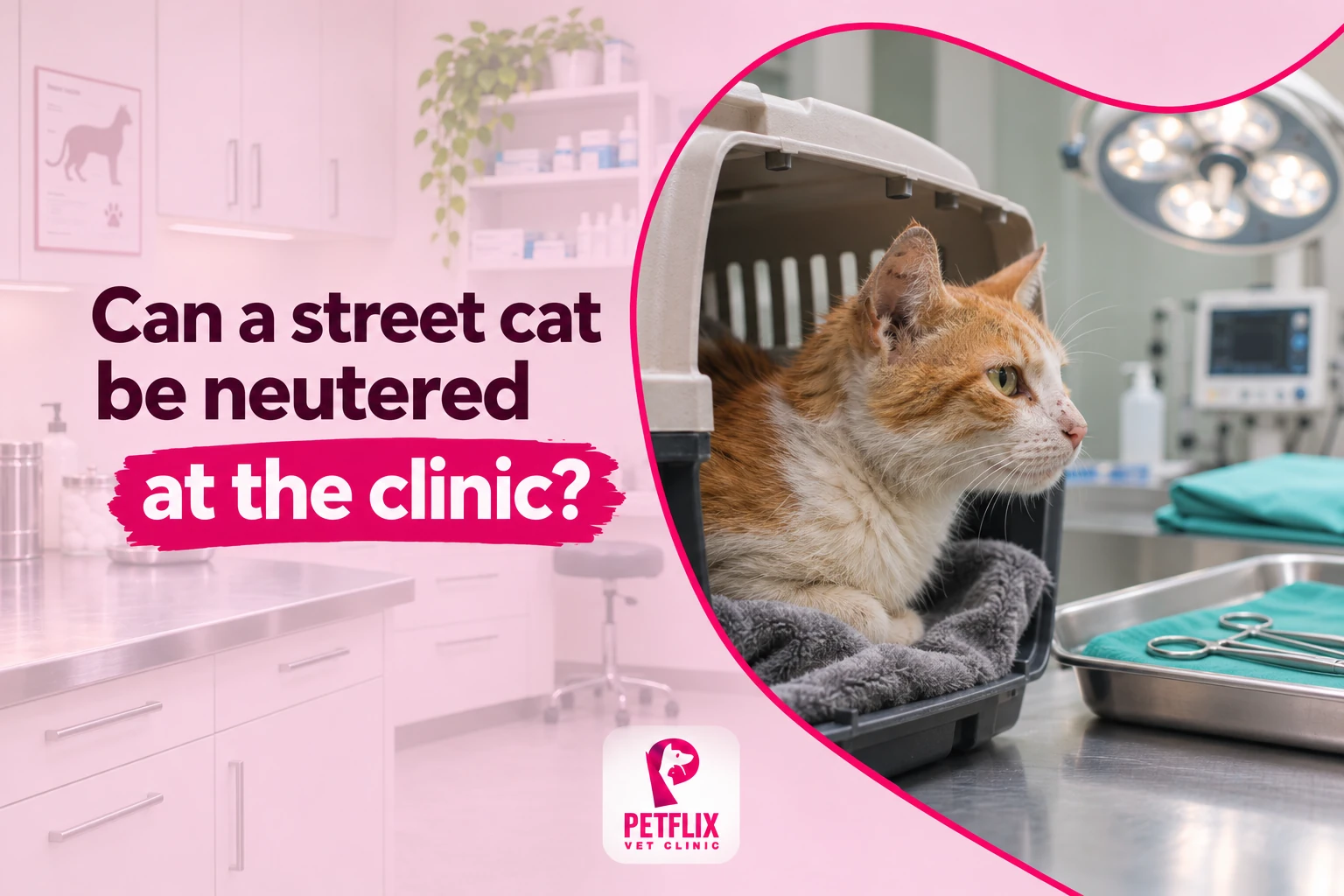
A stray cat you have adopted is checked for fleas, ear mites and ringworm first, then booked like any other. The order matters, because the retrovirus result and the parasite treatment belong before the anaesthetic rather than after it.
Frequently asked questions
Three questions owners ask us in the first week with a rescued cat.
What do you do if you find a stray cat?
Decide first whether it needs help at all, since a healthy adult that avoids you is better left in its territory. If it is hurt, very young or clearly a lost pet, confine it in a carrier, keep it away from your own animals, and book an examination with a microchip read before anything else.
What is the 3-3-3 rule for cats?
It is a rehoming rule of thumb, three days to decompress, three weeks to learn the routine and three months to settle, and it comes from shelter practice rather than from veterinary research. Treat it as a reminder to be patient, and not as a timetable that a frightened cat has agreed to.
What calms a frightened cat indoors?
Height, cover and distance, in that order. A shelf or a box the cat can retreat into, a room where nobody reaches for it, and food left and walked away from. If a cat that was calm turns aggressive, that is an examination rather than a behaviour problem, because pain comes out as temper.